Create and Manage Sub-Work Orders
| Platform: | AvailableWebAvailableMobile |
|---|---|
| Plan Type: | Not availableBasicNot availableEssentialAvailablePremiumAvailableEnterprise |
| User Type: | Not availableRequesterAvailableFull UserAvailableAdministrator |
When you create a work order, you can add multiple sub-work orders for maintenance to assets, or other work. The initial work order becomes the parent work order, where you track the overall progress of the work and manage the sub-work orders. For more information, see Parent and Sub-Work Orders.
This article explains how to create and manage sub-work orders.
-
Add sub-work orders when you create a new parent work order or edit an existing one. When you save the parent work order, MaintainX® creates the sub-work orders automatically.
For details, see Add Sub-Work Orders to a Work Order.
-
You can edit sub-work orders either while you create the parent work order or after you create the parent work order and its sub-work orders.
For details, see Edit Sub-Work Orders.
-
You can delete unneeded sub-work orders while you're creating or editing the parent work order.
For details, see Delete Sub-Work Orders.
Add Sub-Work Orders to a Work Order
You can add sub-work orders to a new work order when you create it, or edit an existing parent work order—one that already has sub-work orders—to add more sub-work orders.
You can add sub-work orders for specific assets, or blank sub-work orders that aren't associated with assets. When you save the work order, MaintainX creates the parent work order and all the sub-work orders you added.
You can't add sub-work orders to an existing work order if it isn't already a parent work order.
To add sub-work orders:
-
Do one of the following:
- Start creating a new work order. See Create a Work Order for instructions.
- Edit an existing parent work order. See Edit a Work Order for instructions.
-
Do any of the following:
- Add sub-work orders for specific assets.
- Add blank sub-work orders that aren't associated with an asset.
-
(Optional) Edit the new sub-work orders to add detail. From the sub-work orders table you can:
- Make some edits inline from the Sub-Work Orders table.
- Make some edits in bulk from the Sub-Work Orders table.
- Select any sub-work order title to fill out its work order form fields.
-
Finish setting up the parent work order and select Create.
Add Sub-Work Orders for Specific Assets
- Web
- Mobile
-
Do one of the following:
- Start creating a new work order. See Create a Work Order for instructions.
- Edit an existing parent work order. See Edit a Work Order for instructions.
-
In the Sub-Work Orders section, select + Add sub-work-orders. The Select assets for sub-work orders dialog opens.
-
Select the assets you want to add.
- Expand parent assets to see their sub-assets.
- Search or use filters to find specific assets by name.
When you're finished, select Create sub-work-orders. MaintainX adds the sub-work orders to the Sub-Work Orders list.
-
Do one of the following:
- Start creating a new work order. See Create a Work Order for instructions.
- Edit an existing parent work order. See Edit a Work Order for instructions.
-
In the Sub-Work Orders section, select + Add sub-work-orders. The Assets screen opens.
-
Select the assets you want to add.
- Expand parent assets to see their sub-assets.
- Search to find specific assets by name.
When you're finished, select Done. MaintainX adds the sub-work orders to the Sub-Work Orders table.
Add Blank Sub-Work Orders Without Assets
Instead of picking assets to create sub-work orders for, you can add blank sub-work orders. Blank sub-work orders are useful for work that's not tied to specific equipment, and for project tracking. You can also edit them to add assets later.
You can create a lot of blank sub-work orders quickly, which is great when you want to structure a complex task right away and finish setting it up later.
To add blank sub-work orders:
- Web
- Mobile
-
Do one of the following:
- Start creating a new work order. See Create a Work Order for instructions.
- Edit an existing parent work order. See Edit a Work Order for instructions.
-
In the Sub-Work Orders section, select + Add sub-work-orders. The Select assets for sub-work orders dialog opens.
-
Select Continue without asset. A new sub-work order placeholder appears in the Sub-Work Orders table.
-
Enter a title for the new sub-work order, and press Enter to add it to the list.
-
Do one of the following:
- Repeat the previous step to add another sub-work order.
- Press Esc or select the (close) icon to stop adding sub-work orders.
-
Do one of the following:
- Start creating a new work order. See Create a Work Order for instructions.
- Edit an existing parent work order. See Edit a Work Order for instructions.
-
In the Sub-Work Orders section, select + Add sub-work-orders. The Assets screen opens.
-
Select Continue without asset. The New Sub-Work Order screen opens.
-
Add a title for the new sub-work order.
-
Optionally, fill in other sub-work order details. You can also do this later.
-
Select Update to return to the New Work Order screen. The new sub-work order appears in the Sub-Work Orders list.
-
Repeat this procedure to add another sub-work order with no asset.
Edit Sub-Work Orders
You can edit sub-work orders at two stages:
- While creating the parent work order. This ensures the sub-work orders are configured exactly as needed when MaintainX creates them.
- After the parent and sub-work orders have been created. This allows you to finish configuring sub-work orders that you added to the parent work order with missing information, or update their details.
In both cases, you can open a sub-work order individually, make inline edits from the sub-work orders table, or apply changes to multiple sub-work orders using bulk editing.
This section explains how to edit sub-work orders by accessing them from their parent work orders. You can also find any sub-work order in any of the work order views, and edit it the way you would any other work order. (See Edit a Work Order).
Edit Sub-Work Orders Inline From the Parent Work Order Form
-
Edit a parent work order (See Edit a Work Order), and navigate to the Sub-Work Orders table.
-
In the row for the sub-work order you want to edit, select any of the following:
- Web
- Mobile
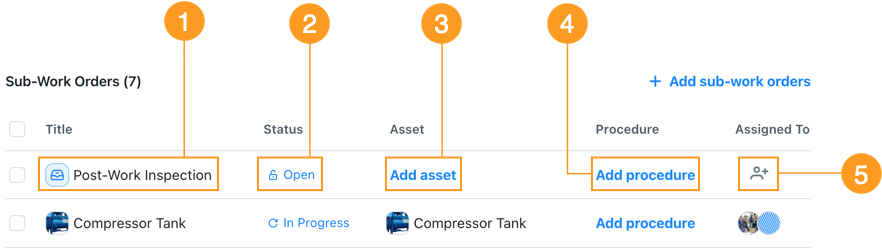
Inline editing options for sub-work orders Select this To do this 1 [Sub-work order title] Edit the sub-work order. 2 Status Change the sub-work order's status. 3 Add asset Open an asset picker and assign an asset to the sub-work order. 4 Add procedure Open a procedure picker and add a procedure to the sub-work order. 5 (add user icon) Assign the sub-work order to teams or users. 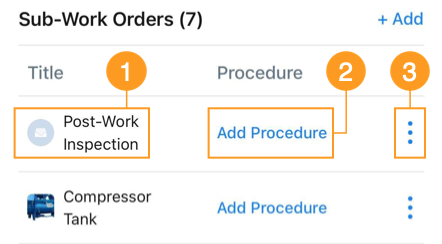
Inline editing options for sub-work orders Select this To do this 1 [Sub-work order title] Edit the sub-work order. 3 Add procedure Open a procedure picker and add a procedure to the sub-work order. 4 (more options icon) Open a menu where you can select additional options, including: - Add/remove procedures.
- Edit the sub-work order.
- Delete the sub-work order.
Bulk-Edit Sub-Work Orders When Creating/Editing the Parent Work Order
This section explains how to bulk-edit sub-work orders when you're creating or editing the parent work order.
-
Edit a parent work order (See Edit a Work Order), and navigate to the Sub-Work Orders table.
-
Select one or more sub-work orders, then select any of the following:
Icon Action Description Rename Add a prefix or suffix to the titles of the selected sub-work orders. The rename dialog displays a sample title with the prefix or suffix. 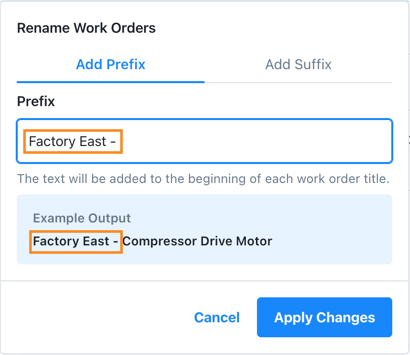
Add or edit asset Open an asset picker and assign the same assets to all the selected sub-work orders. Edit Assignees Assign all the selected sub-work orders to the same teams or users. Edit procedure Open a procedure picker and add the same procedure to all the selected sub-work orders. Delete Delete the selected sub-work orders.
Bulk-Edit Sub-Work Orders from the Parent Work Order Details
This section explains how to bulk-edit sub-work orders when you're viewing the parent work order's details.
-
Open a parent work order to view its details, and navigate to the Sub-Work Orders table.
-
Select one or more sub-work orders, then select any of the following:
Icon Action Description Rename Add a prefix or suffix to the titles of the selected sub-work orders. The rename dialog displays a sample title with the prefix or suffix. Update Status Change the selected sub-work orders' status. 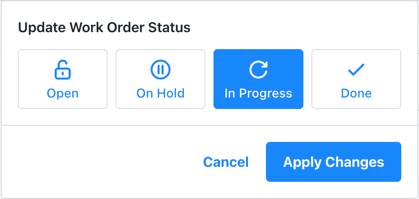
Edit Assignees Add or remove assigned users or teams from the picker. Use the search to find users or teams by name. 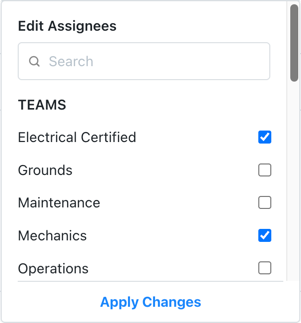
Edit Due Date Select a new due date from the date picker. You can also add a Due Time or Start Date. 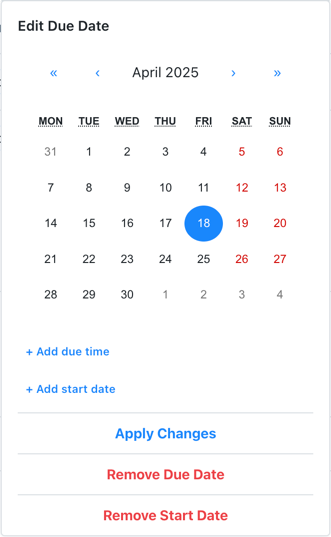
Clear selection Deselect any selected sub-work orders.
Delete Sub-Work Orders
-
Do one of the following:
- Edit a parent work order (See Edit a Work Order).
- Open a parent work order to view its details.
-
Navigate to the Sub-Work Orders table.
-
Select one or more sub-work orders, then select Delete.
You can also find any sub-work order in any of the work order views, and delete it the way you would any other work order. (See Delete a Work Order).